Hard-to-Reach Scrap Car Pickup — No Keys, Seized Wheels, Backyards & Basement Carparks
The car with no keys and four flat tyres. The Corolla rusted to the lawn behind the shed. The Odyssey in a basement with a 2.1 m height bar. Here's how hard scrap car pickups actually get done, what the truck has to carry, and how to make sure the price you're quoted doesn't fall on the driveway.
✍️ By Leo Raines — Scrap Car Buyer Specialist, South Auckland · Published 7 October 2026
Quick answer: Nearly every "impossible" scrap car can be collected. No keys, flat tyres, a dead battery, a locked automatic, seized brakes, a car wedged down the side of the house, at the bottom of a basement carpark or halfway up a steep Manurewa driveway: all of these are normal jobs when the truck turns up with the right gear, meaning a winch, wheel dollies, skates and a snatch block. Problems almost never come from the car. They come from a buyer not being told about the access before the truck is sent, which leads to a wasted trip, a second visit, or a driver trying to cut the price on your driveway. Send four photos and a short description when you ask for a quote, and the offer you get is the offer you're paid.
What this guide covers
- Why access is the part nobody talks about
- What a properly equipped pickup truck carries
- When the car itself won't cooperate
- When the location is the problem
- The hard-access cheat sheet
- The four photos that get you an accurate quote
- The pickup-day price drop, and how to stop it
- Getting ready for pickup day
- The few jobs that need a plan B
- Frequently asked questions
Why access is the part nobody talks about
Every cash for cars website, including ours, says the same three things: top cash, free removal, any condition. What none of them explain is what happens when the car is physically awkward. It might be a Corolla that hasn't moved since 2021, with four flat tyres and the handbrake rusted on. It might be an Odyssey in a Flat Bush apartment basement with a 2.1-metre height bar. It might be a Hilux at the bottom of a rural Waiuku paddock after a wet week.
Those cars make up a big share of what we collect. In our experience the most common reason a scrap car sits for years isn't that the owner wants to keep it. It's that they assume it can't be got out, or that getting it out will cost them money. Neither is usually true.
This guide goes through what the industry does when a pickup is difficult: the equipment, the techniques, the situations where it really does get hard, and what you can do beforehand so the truck only has to come once.
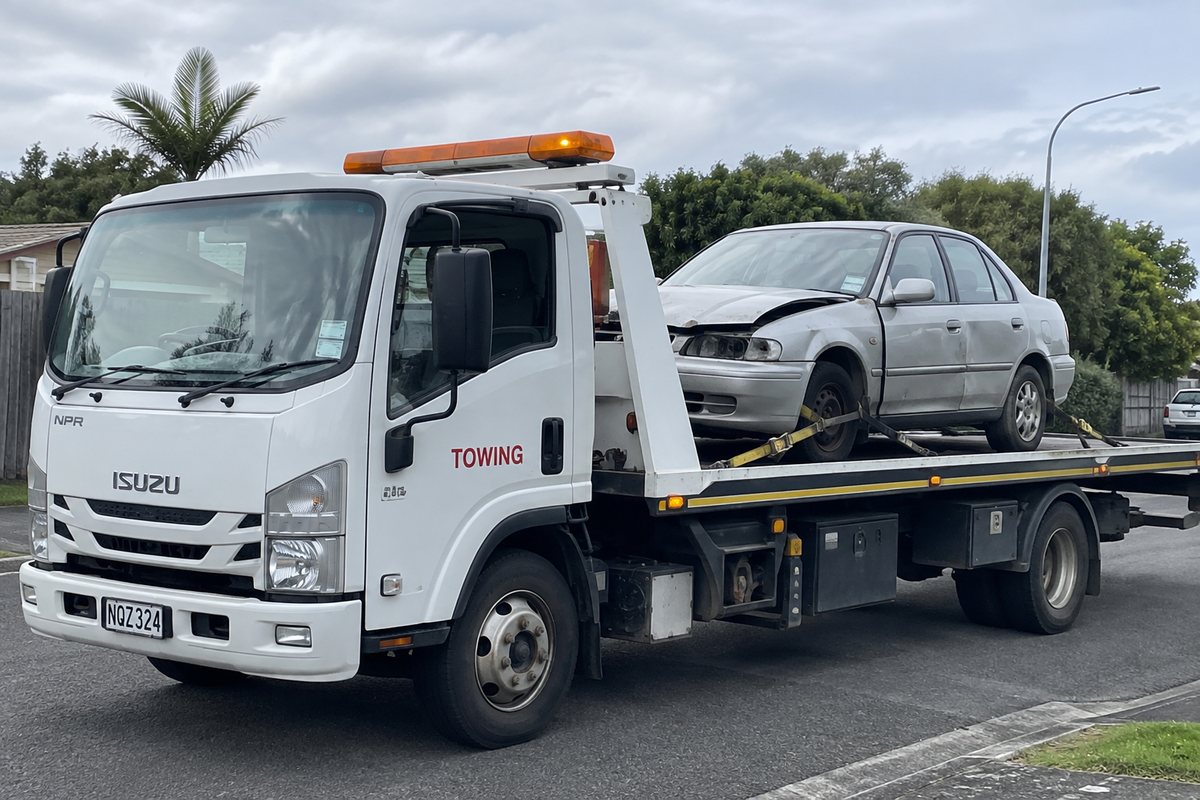
What a properly equipped pickup truck carries
Before you book anyone, it helps to know what "properly equipped" means. A collector who turns up with only a tilt-tray and a hopeful attitude can load a car that rolls and steers. Anything else needs some of the kit below.
| Equipment | What it does | The problem it solves |
|---|---|---|
| Tilt-tray with winch | The deck tilts to the ground and a cable winch pulls the car up onto it | Non-running cars, no keys, dead batteries. The engine never needs to start. |
| Wheel dollies (go-jacks) | Ratchet jacks that lift each wheel onto small castors | Locked steering, an automatic stuck in Park, seized brakes, or a car that has to be shuffled sideways out of a tight garage |
| Skates / skid plates | Low steel sleds that go under a hub or a flat, rimless wheel | Tyres off the rim, missing wheels, a car sitting on bricks or axle stands |
| Snatch block | A pulley that redirects the winch cable around a corner | A car that isn't lined up with the truck, such as one down a side path or around a carport post |
| Long winch cable and extension strops | Lets the truck stay on firm ground or the street while the car is pulled to it | Backyards, lawns, soft paddocks and long or steep driveways |
| Booster pack and basic tools | Temporary power, plus the means to release a stuck handbrake or a shift lock | Electronic park brakes and automatics that need power to come out of Park |
When you're comparing collectors, ask whether the truck carries dollies and skates. It's a simple question, and the answer tells you whether they've done hard jobs before.
When the car itself won't cooperate
No keys
Having no keys causes two separate problems, and people often mix them up. The first is that the car won't start. That doesn't matter, because the winch does the work. The second is that the steering lock is engaged, so the front wheels are fixed at whatever angle they were left at. The fix is to put dollies under the front wheels so the car can be steered by hand while it's winched. It adds about ten minutes.
Lost keys don't stop a sale. What matters is that you can show you're entitled to sell the car. Our guide to selling a car that isn't in your name explains what proof a legitimate buyer will ask for.
An automatic stuck in Park
An automatic in Park has a pin locking the transmission, so the driven wheels won't turn. If there's battery power and a key, the driver simply shifts to Neutral. Without either, many cars have a shift-lock override, a small slot near the gear lever. If that fails, the driven wheels go on dollies. It looks dramatic and is routine.
Flat battery and electronic park brakes
A flat battery on its own doesn't matter for an older car. It matters more for anything from roughly the last fifteen years with an electronic park brake, a button instead of a lever. Those need power to release. A booster pack usually does it, and if the system has failed outright, the rear wheels go on dollies. Hybrids and EVs need a little more care, which we cover in the EV and hybrid guide.
Seized brakes and wheels
This is the classic problem with a car that's been parked on the lawn for years. South Auckland's damp winters rust brake discs and handbrake cables surprisingly quickly, so after a year or two of sitting still, one or more wheels often won't turn. A winch can usually drag a seized car up the deck. The tyres scuff, but that doesn't matter for a car going to scrap. Where dragging would damage your driveway or lawn, the seized corners go on dollies or skates instead.
Flat tyres, or no wheels at all
Flat tyres are a non-issue, because a flat tyre still rolls onto a tilt-tray. Tyres that have come off the rim, or cars sitting on bricks with the wheels gone, need skates under the hubs. Tell us when you call, because a car on blocks needs a truck that's carrying skates, and not every run does.
Stripped shells, crash damage and fire damage
A shell with no engine, interior or doors is lighter and easier to move than a whole car. Crash-damaged cars with pushed-in wheels are handled the same way as cars with seized wheels. Fire-damaged cars can usually be collected too. Just mention the fire so the driver can plan the tie-downs. See accident-damaged car removal for more.
When the location is the problem
Backyards, side paths and behind the house
This is the most common hard-access job in South Auckland. The car went in years ago when it still drove, and since then a fence, a shed or a garden has grown up around it. The question is whether there's a clear path from the car to somewhere the truck can park. The car's own wheels, dollies or skates do the rest.
- Gate width. As a rule of thumb, a typical car is about 1.7–1.8 m wide. A gap of about 2.2 m or more gives enough room to dolly or winch it through. A narrower gap often means taking off a gate or a fence panel for an hour, which you can usually refit straight after.
- Corners. One corner between the car and the street can be handled with a snatch block. Several tight corners need more planning, and photos help a lot.
- Distance. Twenty to thirty metres of winch line covers most suburban sections from the kerb.
Lawns, paddocks and soft ground
South Auckland's heavy clay soils turn to grease after rain. A loaded tilt-tray weighs many tonnes, so driving it onto a wet lawn or paddock risks bogging the truck and ripping up your grass. The fix is to keep the truck on hard ground and winch the car to it. Rural pickups in places like Waiuku, Clevedon, Karaka and Tuakau often go best after a couple of dry days. If your farm track is marginal, say so and we'll book the pickup for when it isn't.
Steep driveways
Many hillside sections in South Auckland have driveways that drop sharply from the street. A car that has to come up the slope is winched the whole way, with the driver controlling it, rather than pushed. A car that has to come down needs working brakes or a controlled winch line to stop it running away. Never try to roll a dead car down a steep driveway yourself to "help".
Single garages and lock-ups
A car parked nose-first in a narrow single garage, with the walls a hand's width from the mirrors, usually can't be steered out. It's pulled straight back on the winch, and dollies are used if the wheels are turned or locked. Clear the clutter from in front of the bumper and along both sides before the truck arrives. For storage-unit lock-ups, check the facility's access hours and gate code, and let the manager know a tow truck is coming.
Apartment and townhouse basement carparks
This is the newest problem, and it's growing fast as more townhouses and apartment blocks go up around Flat Bush, Takanini, Hingaia and Manukau Central. Most basement entries have a height bar of about 2.1–2.3 m. A tilt-tray won't fit under that, so the truck never goes underground. Instead the car is winched or dollied up the ramp to street level and loaded there. A few things make this go smoothly:
- Tell the body corporate or building manager, and book a time if the building requires it. Some buildings have rules about contractors and blocking the ramp.
- Find out the exact clearance and the ramp gradient, and sort out access fobs or codes for the driver.
- Check the bay. A car hemmed in by a pillar and a neighbour's car may need dollies to move it sideways first. Ask the neighbour to move their car if they can.
Street parking, cul-de-sacs and power lines
In older streets in Otahuhu, Papatoetoe and Mangere, the hard part is often just finding room for the truck. A tilt-tray needs roughly a car and a half of kerb space, plus room to tilt the deck. Overhead power and phone lines are a quiet hazard because the deck rises as it tilts, so the driver will pick a spot clear of them. If a car has been sitting on the street unregistered, deal with it sooner rather than later. Auckland Transport can tow abandoned or unregistered vehicles, and you don't want storage fees on top.
Cars at a mechanic's workshop or panelbeater
If the repair quote came in higher than the car is worth, it can be collected straight from the workshop. Let the workshop know, settle any bill for work already done or diagnostics, and confirm their opening hours. If you're still deciding, read repair or scrap first.
The hard-access cheat sheet
Use this table to find your situation and see what to tell us when you call.
| Situation | How it's handled | What you can do beforehand | Same-day still likely? |
|---|---|---|---|
| No keys | Winch, with dollies under the front wheels if the steering is locked | Say so on the call | Yes |
| Flat battery | Winch, or a booster pack for electronic park brakes | Nothing | Yes |
| Automatic stuck in Park | Shift-lock override or dollies | Leave the key in the car if you have one | Yes |
| Flat tyres | Rolled or winched as normal | Nothing | Yes |
| Seized brakes or wheels | Dragged on the winch, or dollies and skates | Mention how long it has been sitting | Usually |
| No wheels / on blocks | Skates under the hubs | Tell us, so the truck carries skates | Often next run |
| Backyard / behind house | Winch line from the street, snatch block for corners | Measure the gate and clear the path | Usually |
| Soft lawn or paddock | Truck stays on hard ground and winches the car | Book for after a dry spell if possible | Weather-dependent |
| Steep driveway | Controlled winch the whole way | Keep the driveway clear of other cars | Yes |
| Basement carpark | Winched or dollied up the ramp and loaded at street level | Tell the body corporate, give the clearance, arrange fob access | Usually next day |
| Single garage, nose-in | Straight winch back, dollies if needed | Clear around the car | Yes |
| At a workshop | Normal pickup in workshop hours | Settle the bill and tell the workshop | Yes |
The four photos that get you an accurate quote
Most failed pickups could have been avoided with a couple of photos from a phone. These four tell a collector almost everything:
- The car from a front corner, showing the condition, the tyres and how it sits on the ground.
- The car from the opposite rear corner, showing any damage, missing wheels and what's around it.
- The route out, taken from beside the car looking toward the street. Include gates, corners, steps and slopes.
- The street or the ramp entry, showing where the truck would park, plus any power lines or height bars.
Add one line of text with the make, model and year, whether it has keys, whether it rolls, and how long it's been sitting. That's enough for a firm quote and the right truck. You can send it all through our online quote form or by phone.
The pickup-day price drop, and how to stop it
This is the part of the industry that gives cash for cars a bad name. A seller gets a good quote over the phone. The truck arrives, the driver walks around the car, and the number suddenly falls: "Didn't say it had no keys, mate." "We'll have to winch it. That's extra." "It's down the back, I can do two hundred less." With the car half-loaded and the afternoon gone, most people give in.
Difficult access is the most common excuse for this, which is why being upfront about it protects you:
- Describe the access and send the photos when you get the quote. If the buyer knew about the seized wheels and the narrow gate when they quoted, there's nothing left to "discover" on the day.
- Ask directly: "Is this the price I'll be paid, given everything I've told you?" A straight buyer says yes. A vague answer is a warning.
- Get the offer in writing, even just a text message.
- Know that you can say no. If the price changes on the driveway and the car matches what you described, you can refuse and keep the car. More on spotting this in how to check a cash for cars buyer is legit.
Our own policy is simple. Removal is free, the hard-access gear is on the truck, and if the car is what you described, the quoted price is the price paid.
Getting ready for pickup day
- Empty the car. Check the glovebox, door pockets, under the seats, the boot and the spare-wheel well. Remove child seats, garage remotes, parking permits and toll or fuel cards.
- Clear the route. Move bins, kids' bikes, other cars and loose pavers from the path between the car and the truck.
- Sort access. Unlock the gates, find the garage key, and arrange fobs and body-corporate notice for basements.
- Have your ID and paperwork ready. We fill in the NZTA notice of disposal at the pickup. If there's finance on the car, sort it out first. See the PPSR guide.
- Be there, or have someone there. The driver calls about 20 minutes before arriving, and payment is made at the handover.
- Think about rego and RUC. Once the car is gone you may be able to claim back unused licensing. See the refund guide.
The few jobs that need a plan B
To be honest, a small number of jobs can't be done with a single truck and a winch, and you're better off hearing that now than on the day:
- A car fully enclosed by a building, with no opening wide enough, like the project car in the back shed that was built around it. Part of the structure has to come out, or the car has to be cut down where it sits.
- A car on a steep bank, in a gully or down a bush track, beyond the reach of the winch line. This usually needs a heavier recovery vehicle or a hiab truck, which we arrange case by case.
- A basement with a long, tight, multi-level spiral ramp and a car that won't roll. It's possible, but needs more people and a booked time slot.
- Waterlogged ground that won't dry out, such as a paddock in the middle of a wet winter. The fix is to wait, not to force it.
Even then, the answer is almost never "it can't be done". It's "it needs a different plan". Call and describe it, and you'll get a straight answer.
Related guides
- Same-day car removal: the timeline from phone call to cash.
- Selling without a WoF or rego: what's legal for a car that can't be driven.
- What your scrap car is worth: how the offer is worked out.
- Scrap car removal: the service page.
Frequently asked questions
Can you pick up a scrap car with no keys?
Yes. A car without keys is winched onto a tilt-tray, so it never needs to start. If the steering lock is engaged, wheel dollies go under the front wheels so the car can be steered while it is loaded. You still need to show you are entitled to sell the car, for example with ID and proof of purchase.
Can a car with flat tyres or seized wheels be towed?
Yes. Flat tyres still roll onto a tilt-tray. Seized brakes or wheels are usually dragged up the deck on the winch, or lifted onto wheel dollies or skates where dragging would damage the driveway or lawn.
How do you remove a car from a backyard?
The truck parks on the street or another hard surface and a long winch line pulls the car out, using a snatch block to get around corners. A gap of about 2.2 metres is usually enough for a typical car. Narrower gates sometimes need a gate or fence panel taken off temporarily.
Can a tow truck get into an underground carpark?
Usually not, because most basement height bars are around 2.1 to 2.3 metres. Instead the car is winched or dollied up the ramp and loaded at street level. Let your body corporate know and arrange fob access for the driver.
Do you charge extra for difficult access?
No. Removal is free, including no-keys, non-running and hard-access pickups. Describe the access and send photos when you get your quote, and if the car matches the description, the quoted price is the price paid.
What if a buyer lowers the price when the truck arrives?
If the car is as you described it, you can refuse and keep the car. Prevent this by describing the access and condition up front, sending photos, asking whether the quote is the final price and getting it in writing.
What photos should I send for a scrap car quote?
Four photos: the car from a front corner, the car from the opposite rear corner, the route from the car to the street, and the spot where the truck would park, including any gates, slopes, power lines or height bars.
Can you collect a car with no wheels sitting on blocks?
Yes. The car is loaded on skates placed under the hubs. Mention it when you call so the truck carries skates. This sometimes means the next run instead of the same day.
This guide is general information based on our collection experience across South Auckland. Measurements are rules of thumb, not guarantees. Every site is different, so describe your situation when you request a quote.
Related Guides
Same-Day Car Removal in South Auckland — How It Actually Works
Read GuideIs Cash For Cars Legit? How to Verify a South Auckland Car Buyer
Read GuideSelling a Car That Isn't in Your Name — Deceased Estates, Abandoned Vehicles & Proof of Entitlement
Read GuideReady for Top Cash in South Auckland?
Free same-day removal across every South Auckland suburb. Top cash on the spot — running or not, any condition, any make.